Overview
This guide explains how to install the QQube Single-User Edition on a Windows workstation for use with QuickBooks Desktop.
The Single-User Edition is designed for one person who uses QuickBooks and creates or refreshes QQube reports on the same computer.
Workstation installation
The standard QQube Single-User installation is designed for a local Windows workstation and will not install on a server.
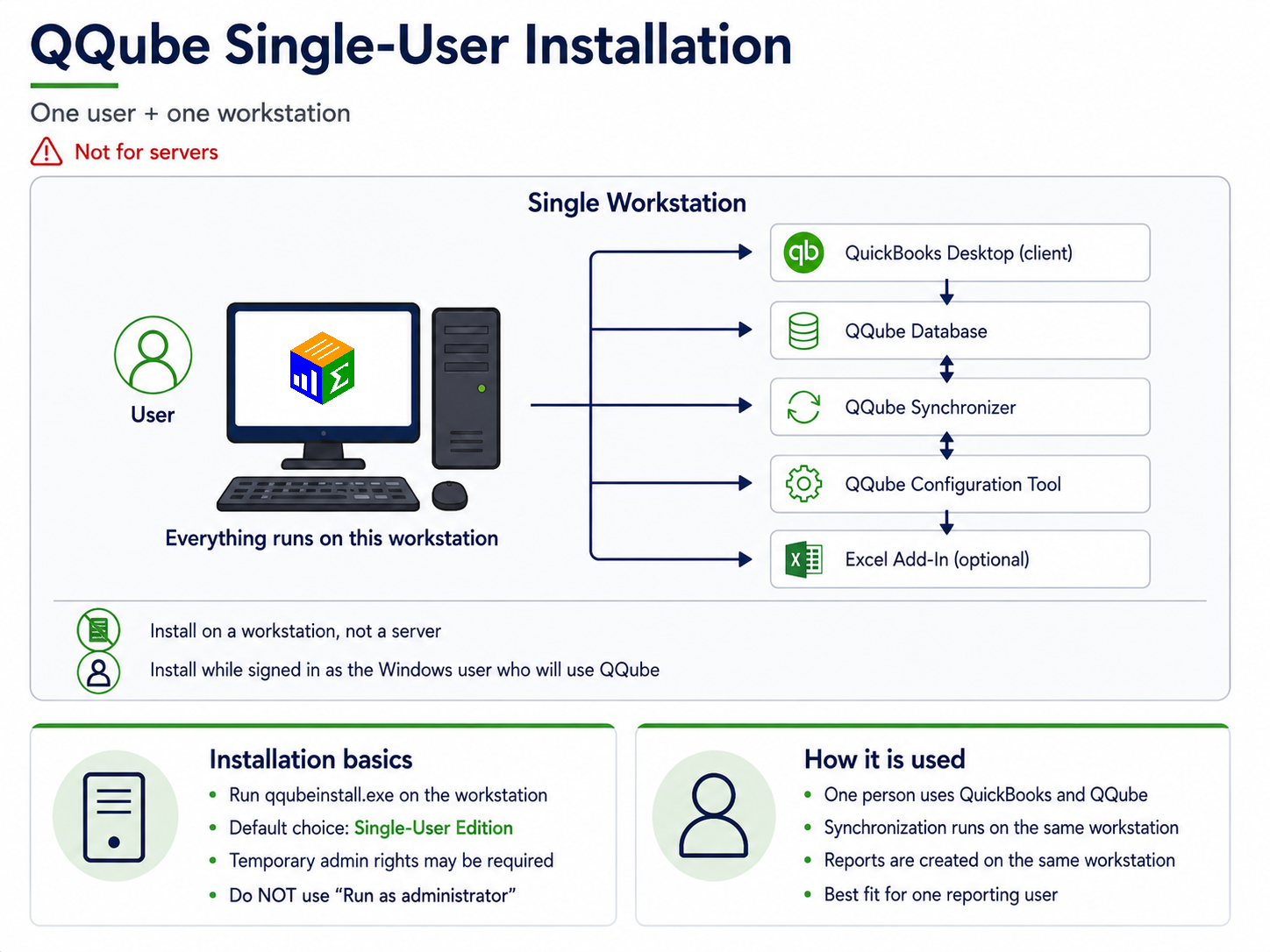
Pre-install requirements
- Review the current requirements.
- Confirm that the workstation is not connected to a network where another QQube engine or implementation already exists.
- Sign in as the Windows user who will use QQube.
- Temporarily give that Windows user administrative rights for the installation. The user may be returned to regular permissions afterward.
- Do not right-click the installer and select Run as administrator.
Install QQube
1. Download and start the installer
Download the current QQube installer: qqubeinstall.exe.
Double-click qqubeinstall.exe while signed in as the Windows user who will use QQube.
2. Choose Single-User Edition
Select Single-User Edition, then click Next.

3. Install the Excel Add-In
If Microsoft Excel is installed on the workstation, the QQube Excel Add-In option will be available. Leave it selected, then click Next.

4. Keep the default installation folder
Keep the default installation folder. It should not be changed.

5. Begin the installation
Review the installation choices, then click Install to begin copying files and installing the required components.

6. Wait for the installation to complete
The installer displays progress while QQube files and components are installed.

7. Finish the installation
Click Finish to complete the installation.

Administrative permissions after installation
If the Windows user does not normally have administrative machine permissions, the user may be returned to regular permissions after QQube is installed.
Without administrative permissions, the user cannot start or stop the QQube Database service. The user can still perform normal QQube functions, including:
- Add or remove QuickBooks company files.
- Run manual synchronizations.
- Review synchronization logs.
- Resolve synchronization issues.
- Create and refresh reports.

What gets installed
- QQube Database.
- QQube Synchronizer.
- QQube Configuration Tool.
- QQube Excel Add-In, when selected.
- Approximately 250 examples for six reporting applications.
- 32-bit and 64-bit ODBC drivers.
- Two standard System DSNs:
- QQubeFinancials.
- QQubeUser.
The standard QQube System DSNs eliminate the need to create custom connection strings.
Next steps
Was this article helpful?
That’s Great!
Thank you for your feedback
Sorry! We couldn't be helpful
Thank you for your feedback
Feedback sent
We appreciate your effort and will try to fix the article