Overview
A report may display incorrect data, unexpected values, or unexplained errors. This can affect both new QQube users and reports that previously worked correctly.
Most data-accuracy problems are caused by synchronization interruptions, QuickBooks file corruption, configuration settings, filters, or report-specific issues rather than a QQube defect.
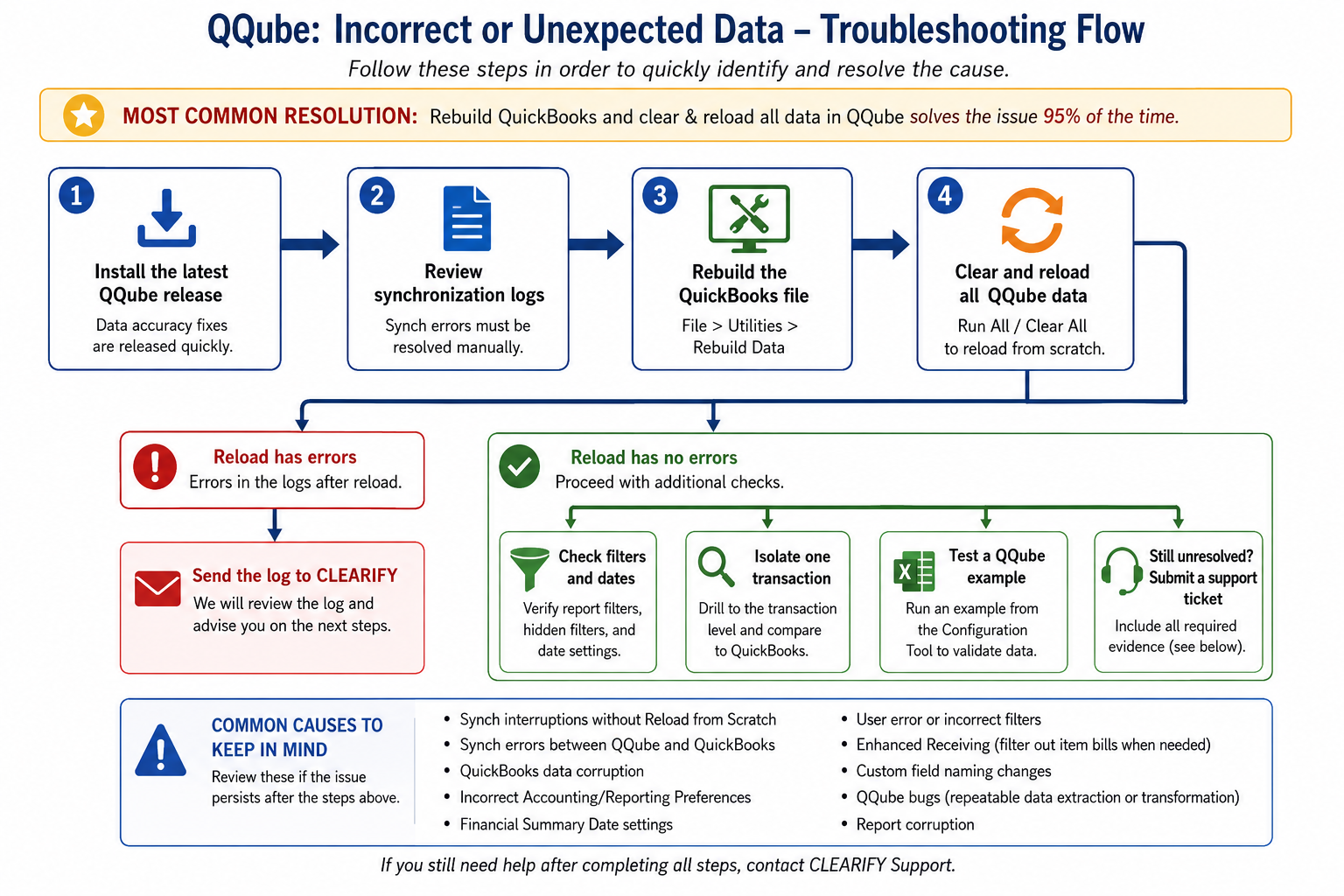
Most common resolution
Rebuild the QuickBooks company file, then clear and reload all QQube data from scratch.
This resolves approximately 95% of reported data problems.
Start Here
Complete these steps in order before troubleshooting the report itself.
1. Install the Latest QQube Release
Confirm that the latest QQube release for your version is installed. Data-accuracy corrections are distributed through QQube updates.
2. Review the Synchronization Logs
Review the QQube synchronization logs.
Any unresolved synchronization error remains relevant even when later synchronization attempts finish successfully.
3. Rebuild the QuickBooks Company File
In QuickBooks, select File > Utilities > Rebuild Data.
Perform the rebuild even when Verify Data reports no problem. Corruption detected through the Intuit SDK may not be reported by the QuickBooks verification process.
4. Clear and Reload All QQube Data
After rebuilding the QuickBooks file, use the QQube Run All / Clear All operation to remove the existing QQube data and reload it from scratch.

The reload time depends on the size of the QuickBooks company file and the speed of the computer. See How the Synchronization Process Works.
After the reload
If the complete reload finishes without errors, refresh the affected report and compare the results again.
If the Reload Has Errors
If the synchronization log still contains errors after the rebuild and complete reload—for example, Error 1000 or unreadable text—select the relevant log and use Send to CLEARIFY.
CLEARIFY can review the log and determine whether additional QuickBooks repair or QuickBooks Data Services assistance may be required.
If the Reload Has No Errors
If the reload finishes successfully but the report still appears incorrect, troubleshoot the comparison rather than repeating the reload.
1. Match the Report Criteria
Confirm that the QQube report and the QuickBooks report use the same:
- Dates or reporting period.
- Posting status.
- Active or inactive record filters.
- Accounting basis.
- Other visible or hidden filters.
Date-controlled data models
Financial Summary data models, Accounts Payable, Accounts Receivable, and Trial Balance may use dates selected in the QQube Configuration Tool. Confirm those settings before adding report-level date filters.
Also check these less common conditions when they apply:
- Enhanced Inventory Receiving: Inventory reports must exclude item bills or both the item receipt and bill may be counted.
- Custom field naming changes: Renaming custom fields can change their retrieval order and affect calculations tied to a specific custom field. See the Custom Fields guide.
- QuickBooks preferences: Review the required QuickBooks preference settings.
2. Isolate One Transaction
Reduce the report to one transaction that demonstrates the problem. Include enough identifying information to match it exactly in QuickBooks, such as document type, reference or transaction number, transaction date, line sequence number, item name, and item description.
Compare that transaction directly with the corresponding transaction in QuickBooks.

3. Test a QQube Example
If the report worked previously but suddenly stopped working, run an Excel example from the QQube Configuration Tool.
If the QQube example works correctly, the issue is likely within the custom workbook or report rather than the synchronized QQube data.
If the Issue Remains
After completing the steps above, create a CLEARIFY support ticket.
Attach:
- The latest QQube synchronization log.
- A spreadsheet containing the single isolated transaction.
- A screenshot of the corresponding transaction in QuickBooks.
- A screenshot of the QuickBooks Transaction Journal for that transaction.
For an invoice, open the transaction and select Reports > Transaction Journal.
Bug-related tickets are investigated and responded to within 48 hours. CLEARIFY may request a copy of the QuickBooks company file when the behavior depends on data that has not been encountered previously.
If the issue is confirmed as a QQube defect, it is added to the correction queue and you will be notified when the fix becomes publicly available.
Support requirements
Complete troubleshooting information is required before CLEARIFY can determine whether the issue is a QQube defect or a report, implementation, synchronization, or QuickBooks data problem.
These steps are also required to avoid a login help-desk charge. Confirmed QQube defects are not charged.
Expected Result
The report should reconcile after the rebuild and complete reload, or the remaining issue should be reduced to a specific transaction or report condition that can be investigated directly.
Was this article helpful?
That’s Great!
Thank you for your feedback
Sorry! We couldn't be helpful
Thank you for your feedback
Feedback sent
We appreciate your effort and will try to fix the article